
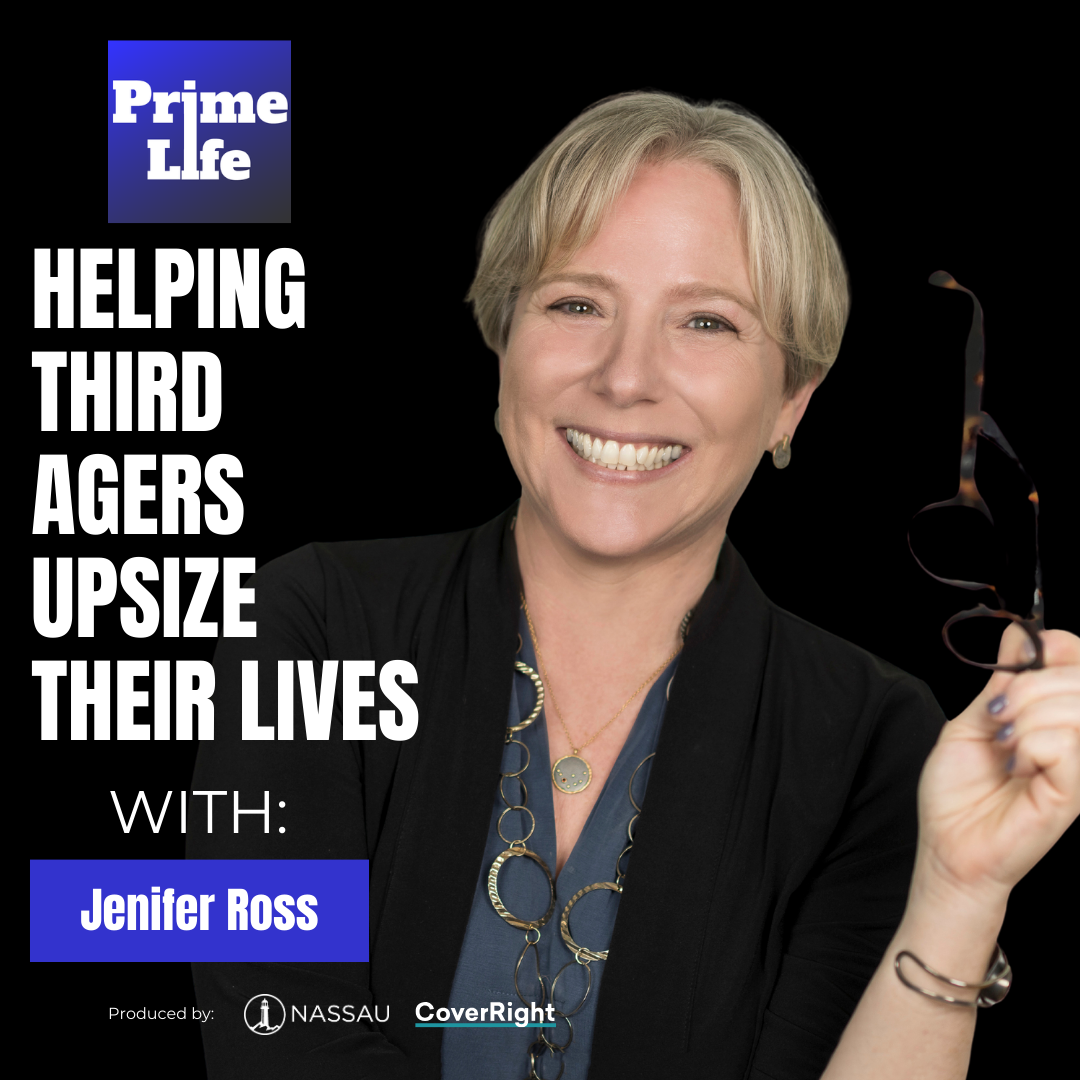
As we age right-sizing, our living space to align with the next chapter of our lives can feel daunting. Jenifer Ross, a Certified Aging-in-Place Specialist, and Certified Senior Real Estate Specialist, discusses how she helps third-agers (older adults) downsize and find their next living situation, whether that’s a smaller home, co-op, condo, senior living community rental, or moving far away to retire or not retire, just to do something different. Jenifer also shares “must haves” for smart technology for living spaces.
Links from show notes:
mary (00:03.438)
Hi, this is Mary Crean and welcome to another episode of the Prime Life podcast. How’s everyone doing today? I hope well. I have an exciting guest to introduce. Her name is Jenifer Ross. She’s a certified aging in place specialist and a certified senior real estate specialist with advanced degrees in architectural preservation and gerontology. As an entrepreneur,
Jenifer has owned numerous businesses, including the first coworking space, and she’s been featured in Entrepreneur Magazine and won her most innovative new business in 914 Inc. Magazine.
Jenifer Ross (00:50.834)
0914.
Mary (00:54.614)
With a 25-year track record of influencing positive change and thinking outside the box. Jenifer, welcome to Prime Life. Please tell our audience a little bit about yourself and kind of give us an overview on your journey and why you’re doing what you’re doing today.
Jenifer Ross (01:13.214)
Well, thank you so much for having me. I’m pleased to be here and excited to be on your podcast. Um, so, you know, basically I arrived at this place in my life from, you know, like any of us having various jobs and wearing so many different hats and then realizing what moves us and what we want our life’s purpose to be around and about. And for me, it’s, it’s come down to really helping, empty nesters and seniors at a certain point in their life, make better decisions about what serves them and how they can literally create their next best life. And I use the term third age, third ager. And third ager is, you know, somebody who’s, who’s not quite ready to tuck themselves in, has still a ton of life left in them and is ready for their next adventure, but they might be held down by a larger home.
um, You know, living in a place that no longer suits them. And so, my, business third age home helps people downsize, find their next best space, and then helps them make changes to that home to make it more, safe, and suitable as they age.
Mary (02:30.69)
Can you tell us a little bit more about what you mean by up sizing your life? That’s the first I’ve heard of that. I love it. It sounds really great, but I’m not sure what it really means.
Jenifer Ross (02:43.352)
So, when people downsize, it can be extremely overwhelming as you can imagine. And there’s so many moving pieces, you know, this part of our life is probably the has the most transitions in it. And I think sometimes people get kind of stuck in a rut and we start to, you know, live day by day doing the same things that we’ve always done.
And when you downsize your home, sometimes that opens up other doors and avenues and opportunities to really upsize your life and get back to some of the things that you’ve enjoyed when you were younger or before you had children. You know, like myself, my kids are out of college. They’re living on their own for the most part. And, you know, now I’ve got parents that are having some other issues, but it’s time. I think it’s time for you. Think of it as a time for yourself to
reinvent yourself or travel more. There’s actually a whole movement for, well actually it’s an organization called the Modern Elder Academy and it’s down in Baja, California, and it’s literally a college or a learning center for people in midlife who are making transitions and rediscovering themselves and how they want to see this next chapter unfold.
and defining it instead of letting it happen to them.
Mary (04:09.91)
I really love what you just said about not letting it happen to them. You and I are in a similar life situation so hearing you speak really resonated with me and I’m sure it’s going to also resonate with a lot of our audience. Can you talk a little bit about Jenifer what should third agers be looking for in their next living situation? I know you talked a little bit about thinking,
what you want this time instead of what others, but I’d be curious to how you suggest others really approach that.
Jenifer Ross (04:43.686)
Mm-hmm. Yeah.
Jenifer Ross (04:50.386)
Mm-hmm. Certainly. So, as a senior real estate specialist, it simply means that I have an expertise in helping older adults downsize and find their next living situation, whether that’s a smaller home, a co-op, a condo, a senior living community or a rental or moving far away, going somewhere to retire essentially or not retire, just do something different. So.
When I help people make these decisions, it really comes down to what they feel is most important to them at that time. Sometimes people want to be closer to their children. So, they’re going to move maybe further away out to California or Nevada, wherever their kids might be to be closer to them. They also might be moving to a city so that they can get out of the suburbs and go back to places where the hospitals are nearby, the theater is nearby, the museums are nearby. You can hail a taxi.
So, it really comes down to like, what does that mean for you? What do you want to, what does your life look like in this next best third age? And in terms of the actual physical setting, I really encourage people to look for environments that are on a single level. That’s one biggie. Stairs can be fine when you move into that place, but come a certain point in your life, people’s knees are giving out, their balance is compromised. So, I really encourage people post.
65 or so to really start thinking about living on one level. That also means that there’s an open floor plan when you’re looking for your next living situation. That means that thresholds are nominal, doorways are larger. You always, you know, there’s so many times that I show somebody a home and you couldn’t get a walker, much less a wheelchair, you know, one day if that’s your situation, through a bathroom door. They are 28 inches and nobody was really thinking.
When these homes or apartments were made 50 years ago, that people would be living into their 70s, 80s, and 90s. We are in a whole different ball game in terms of what’s remaining after we retire or slow down or make a shift. So, these homes weren’t really designed. And one of the things that I have studied in my past is universal design. And that’s really the idea that spaces should be designed for all people of all ages and all abilities.
Jenifer Ross (07:14.93)
And it’s really not the case. There’s typically designed for the six-foot able-bodied male. And that’s stemming from years and years of those people designing for those spaces. And so, I really, I try to help people understand what’s going to be easily adaptable and you know, what your basic thing should be just getting started. So, you’re not walking into a place that the bathroom is on the second level and there’s nothing on the first floor for you.
Mary (07:42.242)
So, it sounds like a few of the things you mentioned may be in the category of the must haves. Could you expand upon that a little bit because I’m not sure if you included all of those or if you could share that with our audience. And then of course, I would love to hear, so I have two-part question, would love to hear about any products that you love and you think all third age homes must have.
Jenifer Ross (07:55.978)
Sure.
Jenifer Ross (08:06.406)
Fair enough, all right. So, I have my kind of like six home features that I think are super essential for anybody who is living where they are, staying where they are, or moving into a new situation. So, number one, I would say are grab bars in your bathroom. I know it may not look so fabulous, but there are wonderful grab bars out there now that are designed by Moen and Kohler, and they can be black, they’re sleek.
but absolutely in spaces where you have the highest likelihood to fall like a bathroom. I encourage people to make sure that they have grab bars or towel bars that look like a grab bar. A curb less shower is on my list. It is super essential that you’re able to not have a tripping hazard of getting in and out of a tub or a lip of a shower. There are beautiful, beautiful options now. I really feel like what’s most important with these products is that design and function are equal, so that you don’t have this big gap of ugly products or ugly situations. I’m an aesthetic human, and I like to have the world around me beautiful. Maybe you do too. So, a curb less shower that has beautiful stones and fixtures and fittings, I would absolutely put a chair in there for later on if you want to sit and bathe. It’s safer that way. An exterior ramp to your home,
even if that’s not necessarily your front entrance, because you may not want that visual, but maybe it’s through your garage or on the side of your house but having a way that you can get into your home with wheels. And that may be that you’re, maybe not you yet, maybe that’s your parents visiting you. And you may be in your 60s with a 90-year-old father that’s coming to visit you, and he’s using a walker, or he’s in a wheelchair. So, making sure that accessibility is there. I would always encourage somebody to implement smart technology in their home.
course we all have, you know, nests and voice activated elements now, lighting timers, not only is that great for someone just to call out a command, but it also has the ability of saving us money by creating knowing when the house is too warm or you’re on vacation, it can adjust, you can do it from your phone. So that’s another one that I highly recommend. A simple one is replacing knobs with handles because as we get a little bit hard ripping abilities get diminished and arthritic fingers come around and it’s just easier to be able to like to slip your hand into a hole than it is to grab a knob. And then I would also, actually two things, I would encourage anti-slip flooring and I would encourage lots of lighting. You know, a poorly lit environment is dangerous.
Mary (10:55.906)
So those are all the things that sound like must haves and also things that, but is there anything that you haven’t mentioned that I know you said earlier and I’m definitely in the camp that you are in terms of wanting things to be aesthetically beautiful that you think that maybe the average person wouldn’t quite think of? For those again of us who maybe want to put aesthetics first, that would be.
Jenifer Ross (10:59.737)
Mm-hmm.
Jenifer Ross (11:10.617)
Mm-hmm.
Jenifer Ross (11:16.338)
Thank you.
Mary (11:22.782)
you know, stimulating to all of our senses, but maybe haven’t thought about it, that would be pleasing. If you could mention one or two items, that would be great.
Jenifer Ross (11:32.658)
Well, sure. I mean, the few that I had in mind are a little bit less about the aesthetics, even though I love that, and more about safety, because there’s not much you can do from a hospital bed. So, one of the things when I was preparing for this was thinking about these questions. And it seems simple, but having an Apple Watch has really become a must-have for anybody living alone.
and it could even be people who are not living alone but are alone quite a bit. Our neighbor, when we first moved into the house with him, and now she lives alone and she had her iPhone up in the kitchen. She went down to her basement to do the laundry on a Friday and she slipped and fell. She laid at the bottom of the stairs for the entire weekend with a broken femur bone. Like crazy, crazy catastrophe and no way to let anybody know she was down there.
until her cleaning lady came on Monday and found her. So having an iPhone on your hand is a very simple way for the rest of the world to be contacted, alerted. It’s just a must have, I feel like. My mother just got one and it makes me feel much safer. She lives alone in New York City, she’s 84, able-bodied, still runs her own business full-time, but this is important. I know where she is also whenever. Another one that I…
think is fairly interesting is a product called Fire Avert, which plugs into your stove and when your alarm, your smoke alarm goes off, it automatically triggers the stove to be turned off. And that’s really great also for people who might be living alone who are beginning to have signs of dementia or just not remembering things and if your battery has died you haven’t noticed. So again, safety first a lot of the times.
Even though I am an aesthetic devotee, I really do believe that making sure you’re safe in your home is a priority.
Mary (13:41.586)
I would agree with you and I love what you just said about the smoke detector turning off the stove. We’ve had a few guests on as a matter of fact, I think one of them we haven’t launched the episode yet and they have a product and they talked about that with sensors and so I think that’s obviously so paramount. So, you know you were saying your neighbor lives alone but nowadays we keep hearing about you know individuals.
Jenifer Ross (13:59.153)
Mm-hmm.
Mary (14:08.61)
cohabitating or co-housing, I think is the phrase that you use. Can you talk a little bit about what that trend may look like and any recommendations you have and kind of what that looks like for those who may be thinking, you know, I want to age in place, but I don’t want to age alone.
Jenifer Ross (14:09.938)
Mm-hmm. Yeah.
Jenifer Ross (14:16.968)
Uh huh. Yeah.
Jenifer Ross (14:26.19)
Right. So, there are numerous trends throughout our country and Europe, of course, where seniors are starting to live together. And there’s actually an interesting website out there. And it doesn’t even have to be seniors living with seniors. It could be seniors living with younger people, you know, multi-generational. So, there’s an amazing website that I found a while back, and it’s still growing and developing. They’re out of Denver and it’s called Silver Nest.
seniors who have homes that are a little bit too large for them, maybe they have two extra bedrooms and it’s basically a room share and they invite you to pay rent but it’s a decreased amount of money and then you’re sort of with that person you’re sharing their environment you may help them with taking the garbage out you know reaching things on high shelves um driving them somewhere but you are living in their home and it’s
I think, you know, a lot of you just heard that Dr. Ruth was named at 98 as the director of loneliness, not director, but she was in New York State, named her the Ministry of Loneliness or whatever. It’s a position where she’s going to be addressing what really is a national problem where people are living alone. You know, you think that so many people live in senior living communities because you see so many advertisements for them. But the truth is that only about 10%, eight to 10% of people live in senior living communities. The other 90% are alone or with their spouses, but they’re aging in place. And so, I think there’s a huge opportunity as people lose their partners to put them together into a small co-living situation. And one of the books that I pulled out just to show those who are seeing this, you know, is a senior co-housing, which so I, you know, it’s certainly happening. And there’s all sorts of communities that are building slightly off the grid because they also tend to be utilizing solar and other lessen your footprint kind of technology and instruments, but at the same time, they’re offering you sort of this.
Jenifer Ross (16:47.89)
co-living where you’re sharing responsibility, you’re sharing making the coffee, you’re sharing the expenses. And like you said earlier, I had the first co-working space in Westchester. So, I come from the sharing economy mentality. And one of my dreams is to create small footprint co-living places for seniors who would like to live together. And they actually do a lot of this more out West where there’s
kind of sprawling ranch style homes that might have six, seven bedrooms where each bedroom is rented out to a different person. And then you might have one bedroom that is available for a caretaker to be there on occasion or for a child to come and stay with you. But they cook together, they eat together, they knit together, whatever it might be. But they live in a cohabitable situation and they have home care that comes to them. So, it really is.
kind of a perfect way in my mind to live out, you know, your last whatever it is, 15 years, with a bunch of other women hanging out, you know, cooking together and feeling safe and feeling connected.
Mary (17:59.834)
I can’t help but harken on the old television program, Golden Girls. Because, you know, and I remember when I was, you know, when I didn’t watch the show when it was on currently, but I remember thinking, oh, that’s interesting. But like how funny that is, right? Because while you were talking, that’s all I could think of. And, you know, you talked about trying to…
Jenifer Ross (18:05.058)
That’s right, exactly, exactly.
Jenifer Ross (18:15.259)
Mm-hmm.
Jenifer Ross (18:21.702)
People say that all the time, yeah.
Mary (18:25.506)
counteract loneliness and all of that and spot on absolutely Jenifer and we’ve had guests talk about that how much that can age us when we’re lonely so you know.
Jenifer Ross (18:30.842)
Yeah.
Jenifer Ross (18:35.914)
Oh yeah, oh yeah. It’s actually, people die of loneliness more than they die of heart attacks. I was reading the article, the article was actually written by my childhood friend, Alison Gilbert, who did the interview with Dr. Ruth in the Times the other day. And that was one of the pieces that surprised me, that you can have more issues health-wise because of loneliness than smoking, literally. And I remember my uncle, Lou, lived to 98, and…
He used to joke; he was always doing like a little standup at our family gathering. And he would, he joked one day that like, if he gets a wrong number, he’s like, oh wait, you know, who are, what’s your name? You know? So that’s real, you know? People are in their homes a lot. We weren’t expecting to live 30 years past retirement. And so, what do you do? How do you find those opportunities to engage with other people? And you know, of course the internet is there for us, but not everybody’s internet savvy.
And there are tons of meetups. There actually, I do events and programming for a golf range in my community. And I was there with them the other day for our 75th anniversary. And there was a woman who was 88. I videotaped her wishing us a happy anniversary. And she said, I’m 88 years old. And this year I’m going to shoot my age. And I play golf three times a week. You got to stay fit and agile. And you know, things still have to excite you.
And that only happens usually around other people. You know, we need other bodies next to us to invigorate and enliven and intergenerational really does, doesn’t have to be senior to senior. You know, I love Meetup because there’s so many opportunities to find people who share your interests. And there’s hundreds of them locally here in Westchester that you can find.
Mary (20:30.678)
You said so many great things just now, and I agree with them. When you talked about multi-generational families, I actually grew up in a family like that. And I know that we’ve heard from other guests, they discuss it’s maybe more prevalent in other countries and that we need to kind of maybe learn from some of the other countries how the many benefits of living with others again and being a lifelong learner. And the social part that you mentioned is absolutely the case. My parents who are still with us and live in their own home, but my mom made a comment when she and my dad went to lunch recently and met up with some old friends. And she was just commenting how my dad was like,
Jenifer Ross (20:57.937)
Mm-hmm.
Mary (21:20.526)
so excited and like it just impacted the rest of his day. And I’m like, of course, like in both of you, you got to see your friends and you got to share some food with them. And you know, you got out of the house, which you need to do sometimes. And so, you know, all of the things that you mentioned, even from my personal perspective that I’m, you know, sharing this with you and our, our audience, um, I’m sure it will resonate with, um, many others. So, you know, I think as we all…
Jenifer Ross (21:24.463)
Yeah.
Jenifer Ross (21:30.791)
Great.
Mm-hmm.
Mary (21:49.034)
begin thinking about, let’s call it the second or third chapter. I know you call it the third age home. And can you prepare a couple of takeaways that our audience can start to think about or even take action on? Because as you said earlier in the conversation, this can be overwhelming.
Jenifer Ross (21:56.234)
Mm-hmm. Yeah, so, yeah.
Jenifer Ross (22:07.398)
Mm-hmm.
Jenifer Ross (22:11.346)
Right, yeah. I think sometimes people don’t give themselves permission to create this new, comfortable, simplified, safer environment for themselves because they’re holding on to these older homes that are expensive. They are maintenance laden. Sometimes they are outside of the community and it’s hard to get to things. But they’re holding on to them because they feel like if they let them go, they’re letting go. They’re.
children’s memories, they’re letting go their deceased husbands’ hard work, they’re letting go all of the opportunities to gather there in the future, but that may not be happening as much anymore and let your children take on this next role of predestination for family gatherings. So, I think part of it is giving yourself permission to live this next best third age and that means being healthier, that means taking care of yourself.
Like I said before, there’s not much you can do from a hospital bed. So, make sure your home is safe and supportive and everything that you can possibly do to prevent a fall has been taken care of. And make space for that next chapter and write it. You know, the worst thing is to be forced into doing something. The best thing is to make that choice yourself. And that means taking the time to make a timeline.
Figure out where you want to go. My mother’s girlfriend has been spending two weeks, then four weeks, then six weeks, my legs just went out, in Porto. And she is testing it. She’s been in New York City for 60 years and she’s now 75 or 80 years old. And she’s experimenting with going to a new place little by little. It’s time. You don’t have to rush into something, but you have to make a plan.
You don’t get in your car and just go; I’m going to go to California and not have a map. You have a destination; you’ve put it into your GPS. You know, if you just got in there and drove willy nilly, you might get there one day. So better to have a real executable timeframe plan. And the other thing that I highly recommend is started to gather the humans that are going to help you accomplish this. That means finding someone who’s going to help you, like a Moves management company, someone’s going to come in.
Jenifer Ross (24:32.814)
and identify the things that you can get rid of, the things you can give away, the things that you are just literally have to toss and that’s okay. Finding people who are going to digitize your pictures so that you don’t have to bring it all with you or donate it. There are always people out there that need the things you don’t want. Someone starting a home. And that’s actually such a mitzvah to be able to give your living room set to a couple that just got married or whatever it is. So, I feel like being able to…
Make that plan and identify the people who are going to help you and involve your adult children. Let’s, you know, find out if there’s things that they want or don’t, you know, have them come and have it been an experience of addressing those things and deciding. And that way you’re in control and everything feels better in my world when you’re in control, you know, where you’re making the decisions and you’re in the driver’s seat. I think that’s one of the things that is hard for seniors and I use that term loosely.
But as people begin to have their role is taken away, essentially in our society, you start to look for other things that you can control. And this is a good one. You can really make this, you can chart out your course essentially, is what I’m saying, be in the driver’s seat.
Mary (25:52.686)
So, it all makes sense and I love the suggestions. And as we kind of are drawing to the end of our episode, we have our final question that we ask each guest. So, Jenifer, you’re very successful. You’ve done many interesting things with your career. What’s your why? Why do you get up every day and why have you chosen to do this?
Jenifer Ross (26:17.846)
is my why. I think part of my why I’ve always been a very happy person and I love to spread joy. I love to laugh and I want to make other people feel comfortable in their skin and their shoes and push the envelope. You know I think it’s um you know I would say that we only live once in this body and you know that’s a nod to the ever-learning process and we’re always growing and
Every day is an opportunity to learn, whether it’s something that was awful that happened to you or something that great happened to you. It’s an opportunity to take that experience and implement it and apply it to other parts of your life and ask that why every day? Why is this happening not to me, but for me?
Mary (27:11.51)
Well, I really love that to me, not for me. Or I love that. I think that’s.
Jenifer Ross (27:16.986)
Right, not to be, you know, I think victimhood is a downward spiral. We want to empower ourselves and those around us. And you can’t do that as a victim. You can only do that as the star of your show. And not everybody wants to be the star. I don’t love cameras and podiums, but you have to embrace it when you’re an entrepreneur and you’re not going to get your message out being in your basement. Well, you can with the internet.
Mary (27:45.742)
Ha
Jenifer Ross (27:46.382)
a computer, but you got to get out there and interact with people and spread, spread some level of joy and optimism every day because it’s hard sometimes with the state of the world. And we all know that it’s hard to turn on the television or the news and not just feel like there is nothing I can do to help her fix this. But I love being able to affect change in my zip code. I love being able to walk out my door and know that I can help people in my own micro community and, and that feels really good.
And I, you know, I’ll take it.
Mary (28:18.75)
I don’t doubt, Jenifer, that you’re making the world a better place where you live and probably far beyond that. As we close our program, if individuals want to get ahold of you, if they’re interested in what you do or they want to look into the services that you offer, what’s the best way for them to get in touch with you?
Jenifer Ross (28:39.946)
Sure. So, they can go to my website, which is third age home spelled out T H I R D A G E H O M E.com. And my phone is always on. Anyone is always welcome to call me or text me. I’m always available to meet a new person and welcome the opportunity to work with people who are looking to downsize, looking to age in place, or just feel like talking about the next best third age.
Mary (29:11.554)
Thank you, Jenifer. It was great to have you. I love your positive spirit. We need more of that in our world, especially as you indicated earlier. So, thank you so much for joining us today. For those of you who are listening to our podcast, feel free to follow us, to like us, to give us feedback. We look forward to seeing and speaking to everyone next time on the Prime Life podcast. Have a great day.
Jenifer Ross (29:14.945)


