
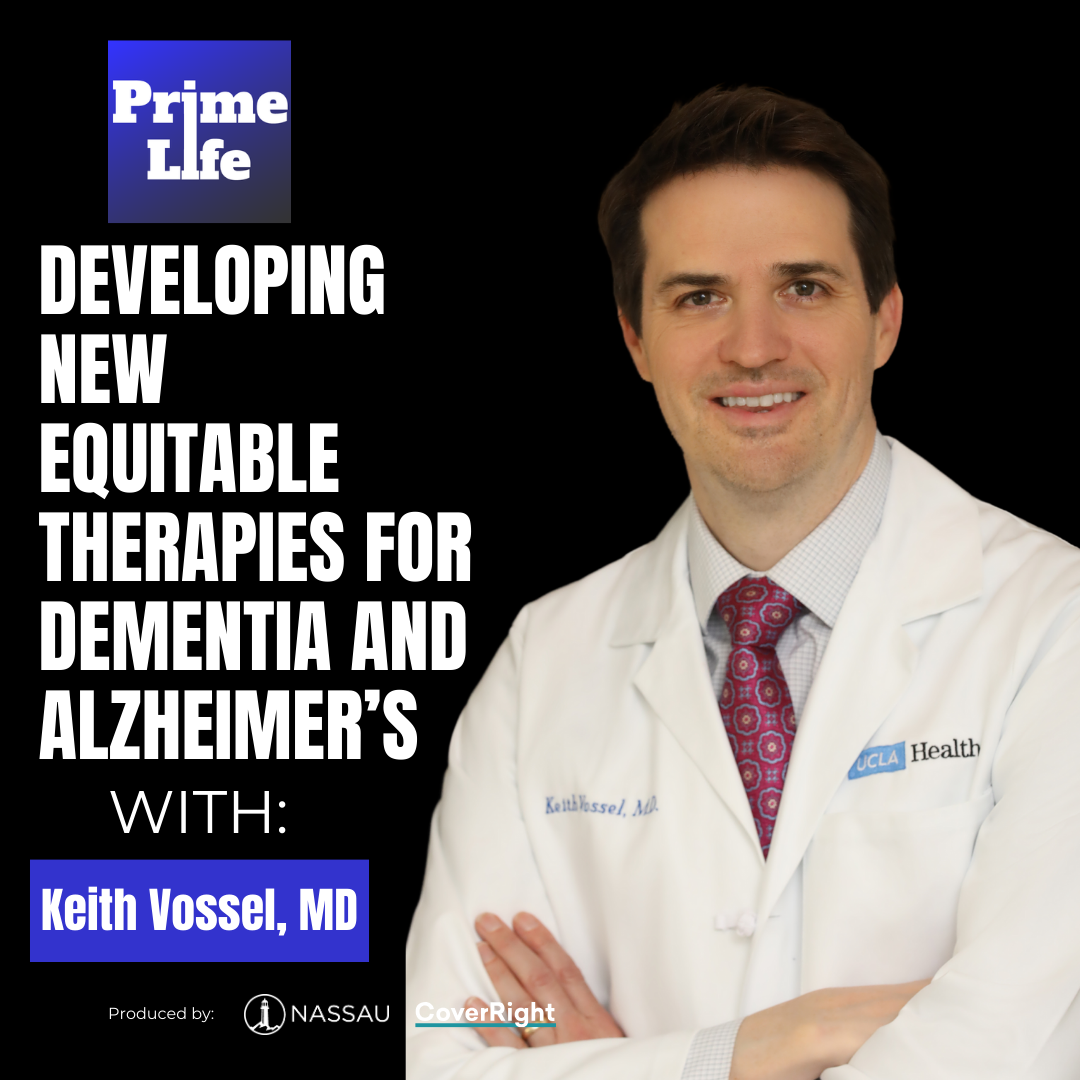
While we cannot reverse all types of dementia, making proactive lifestyle changes may help reduce the risks to help you live longer. Professor of Neurology and the Director of the Mary S. Easton Center for Alzheimer’s Research and Care at UCLA Keith Vossel, MD, shares how he educates his patients using the acronym, Be Smart (blood pressure, exercise, stop smoking/socialize/sleeping well, Mediterranean diet, hearing aides, relax and try something new) to help decrease their risk of dementia. Dr. Vossel discusses how he and his team are finding ways to make access to Alzheimer’s drugs more equitable and support families of those impacted by a loved one with Alzheimer’s.
X
Intrigued by what you heard? Learn more from guests just like this: https://primelifepodcast.com
AI-generated Show Notes:
SummaryDr. Keith Vossel, a professor of neurology and director of the Mary S. Easton Center for Alzheimer’s Research and Care at UCLA, discusses dementia, equity recognition, and treatment options. He emphasizes the importance of early diagnosis and the need for increased recognition and care of dementia in all communities. Dr. Vossel also provides practical lifestyle interventions to promote brain health and reduce the risk of dementia. He explains the concept of neuroplasticity and the importance of trying new activities to stimulate the brain. Additionally, he discusses the current treatment options for dementia, including amyloid-lowering therapies. The episode concludes with Dr. Vossel sharing his motivation for working in Alzheimer’s research and his future research plans.
Takeaways
- Dementia is an umbrella term for cognitive decline that impacts daily life. Early diagnosis and recognition are crucial for effective treatment.
- Lifestyle interventions, such as maintaining blood pressure, exercising, socializing, and following a Mediterranean diet, can reduce the risk of dementia.
- Neuroplasticity allows the brain to create new connections and pathways, making it important to try new activities and stimulate the brain.
- Treatment options for dementia include medications that improve memory and cognitive functions, as well as amyloid-lowering therapies.
- Screening for dementia should be a routine part of wellness visits, and primary care doctors should be trained to identify early signs of cognitive decline.
Chapters
00:00 Introduction and Guest Introduction
03:04 Understanding Dementia and Equity Recognition
06:13 Preventing Dementia through Lifestyle Interventions
11:10 Neuroplasticity and Trying Something New
12:45 Treatment Options for Dementia
24:27 Early Diagnosis and Screening for Dementia
28:20 Practical Takeaways and Brain Health
30:00 Dr. Vossel’s Motivation and Future Research
32:40 Closing Remarks and Contact Information
Josef Katz (00:02.158)
Hello everyone, welcome to another episode of the Prime Life Podcast. I’m here today with my cohost, Mary. How are you doing today?
mary (00:11.054)
I’m doing exceptionally well today because we have an exceptional guest and of course because I’m here with you, Joseph.
Josef Katz (00:18.926)
Well, that’s too kind of you to say. Mary, why don’t you introduce our guests because I’m excited to dive into this topic.
mary (00:26.522)
He’s an amazing person, I’ll just tell you. And my intro will be short and will not do it justice. We’re gonna let him talk about his journey and all of the amazing things that he’s done in his career to date. I’m so happy to introduce Dr. Keith Vossel to Prime Life Podcast. He’s a professor of neurology and the director of the Mary S. Easton Center for Alzheimer’s Research and Care at
UCLA. He leads a comprehensive center incorporating outreach and engagement to develop new therapies for Alzheimer’s and related dementia and achieve equity in recognition and care. Dr. Vassal, welcome to our program. Tell us a little bit about yourself and why you’ve gone into the world of Alzheimer’s.
Keith Vossel (01:23.641)
Thank you, Mary and Joseph, glad to be here. So I am a behavioral neurologist, which means I care for patients who have concerns about their memory or other cognitive areas. And so I got into this field many years ago when I was a student in Memphis as a medical student. And even prior to that as a graduate student, I just really became fascinated with the brain. We were studying the spinal cord and I was working with
neurosurgeons who taught me about the neuroanatomy. We were actually looking at a condition of aging called basically arthritis of the spine and how that can be treated surgically. So I learned a lot about neuroanatomy and that really was the spark that I needed to get into this field. So it’s been a journey where I’ve trained in residency in neurology and then in fellowship training for behavioral neurology at UC San Francisco.
spent a lot of time in Minnesota before coming to UCLA, but really glad to be here and help our center grow to meet the real needs of the community in Los Angeles. There’s really a growing need for recognition and care of dementia in all groups, and that is our prime goal here.
Josef Katz (02:45.538)
So I’ve taken one class, maybe two classes in neuroscience and neuroplasticity. So that’s my depth in the science side of things. But I’d love for you maybe explain what dementia and equity recognition means and how should people be thinking about that?
Keith Vossel (03:04.405)
Yeah, so dementia is kind of like an umbrella term that just means that people are not thinking as well as they used to be. There could be many causes. Some of them are reversible and some of them are not. But now we have new treatments that can help people in the earliest stages of Alzheimer’s disease, which is the most common form of dementia. And we just use the word dementia to refer to people that are having enough impairments in their thinking abilities to where it’s impacting their daily lives. So they’re not able to drive like they used to, or they may get lost, or they’re not able to handle their finances.
We’re actually looking for diagnosing people in earlier stages of cognitive decline, and that condition is called mild cognitive impairment. So that’s a condition that may lead to dementia, but it just means that people are having more trouble with their memory or other cognitive functions than people of their same age, and they often come to clinic with these concerns. And we just work that up. You know, we do some brief history taking and some cognitive tests, and then we just determine what our level of concern is,
We will order further tests as needed. But the problem right now in our field is that dementia is just not recognized as much as it should. There are many reasons for that. Many people think that just memory loss is a function of aging. And that can be even more common medically underserved communities. So we’re trying to get the word out that we should all be able to live long and healthy lives and be able to maintain our memories throughout our lives. So that’s one part.
And the other part is just we don’t have the capacity as doctors to spend the time we need with the patients to screen for dementia or really discuss people’s memory problems. That comes up a lot in memory clinic and we do get a lot of referrals from primary care doctors. But one of our goals is to train primary care doctors on how to screen for dementia in a really quick and efficient way. And so we’ve developed a dementia screening toolkit.
which involves some questions about memory and language and personality. And these are directed towards the patient as well as a partner, if they’re able to come with a patient. And it also involves like a really quick cognitive evaluation. So overall this screening evaluation just lasts like five minutes and we can gather a lot of information from that. So in the future we envision these types of things being done at wellness visits and anyone over the age of 60, just like we do
Keith Vossel (05:32.093)
screening exams for breast cancer and colon cancer, we really need to start screening for dementia. And that’s really a major goal of our center.
mary (05:43.934)
So I love hearing that and makes total sense to me. And I have a lot of questions in my head, but I know I’m only limited to one right now. In that, I’m very curious. You said that some forms of dementia are, can be reversed and others cannot, or my words, not yours exactly. And I know we’ve been hearing about lifestyle, how that has an impact. So I’d love for you to talk a little bit about what people can do.
to hopefully decrease the risk of having dementia.
Keith Vossel (06:20.605)
Yes, so in terms of reversible dementias, we think about vitamin deficiencies or sometimes hormone imbalances that can lead to cognitive problems or metabolic derangements. And these things can be fixed with medical care. And so we often, we always look for any kind of infection or autoimmune disease or any kind of metabolic derangement that can be addressed.
Now, in terms of things that people can do to promote brain health and reduce risk of dementia, we actually know now that roughly 40% of dementias could be preventable with lifestyle interventions. And these really relate to a few simple things. And I’ve actually come up with a little bit of a mnemonic for this. It’s an acronym called B-Smart. And so I like to use this now in clinic and just talk about things that are really proven to be beneficial for brain health.
So B stands for blood pressure. And now we know that keeping that blood pressure below 120 on the high side is really beneficial for preventing dementia. There was a recent study called the Sprint Study where they enrolled middle-aged to older adults who had high blood pressure and they put them on an aggressive anti-hypertensive regimen. And they found that those who were on this blood pressure regimen and were able to achieve a lowering
blood pressure with a goal of 120, they had a lower risk of developing cognitive decline as they got older. And so that’s a really key study that I cite in my clinic. So the other thing is exercise. Exercise is beneficial for the body. It really helps improve our mood as well as it can do a lot of things in the brain like improve the brain’s ability to regenerate
new brain cells. It actually stimulates stem cell generation. And so we recognize, we recommend 150 minutes of exercise a week. So that includes mostly cardiovascular exercise to get that heart rate up. And so that’s the E. The S in B-Smart stands for a few things. One is to stop smoking if one is smoking cigarettes. The other is to socialize and really stay active with the community and with friends and family.
Keith Vossel (08:47.137)
We really know that is good for the brain to stay engaged. And the other S is for sleeping well. There’s a range of sleep that people need, and everyone’s different. Some people need like six hours of sleep. Some people need like eight or more. But something in that range between six and eight hours is really recommended. And if people are snoring or having pauses in their sleep where they stop breathing, that could be addressed as well because sleep apnea.
is a common cause of headaches and cognitive problems in older adults. M stands for Mediterranean diet. That essentially means cooking with olive oils, having fish instead of red meat when possible, green leafy vegetables and colorful fruits and vegetables, a handful of nuts a day. These types of things are really helpful. The next thing is A, which stands for hearing aids.
We think that roughly 7% of dementias could be preventable by improving hearing. And so oftentimes people are not wanting to wear hearing aids, but it’s really important because the brain has to really be able to receive the stimulation that it needs throughout the day to maintain its usual integrity. And so hearing aids is really important.
R is something that everyone likes. R stands for relax. And R means, so relax just means that you should really try to check out when you’re not at work and do things that you enjoy. Try not to really dwell on things that get one down and try to limit one’s stress. We know that stress is really a factor that can impact one’s body as well as mind. And finally T is for trying something new.
Sanjay Gupta has a nice book out about promoting brain health and he also recommends this. So this includes just trying a new book or trying to learn a new language or if one is not used to visiting museums or learning about new artists, that might be something that one could try. But essentially just trying ways to stimulate that brain and exercise parts of the brain that may not be exercised as often.
Josef Katz (11:10.718)
I love the be smart. I think a lot of that is things we’ve heard from other guests on the show. But the, uh, the last one I’ll just try something new with it’s probably tied to neurology, right? You have the neuroplasticity of the brain and be keeping the synapses firing and all that good stuff. Right. Is that, is that the science there at a simple level?
Keith Vossel (11:31.629)
Yeah, at a simple level, it is. It’s essentially, like you said, it’s creating new connections in the brain. The brain is very resilient. Even in people that develop memory loss, there are many parts of the brain that are functioning well and can still continue to create new pathways. So it’s definitely something we encourage. We definitely make sure that people are not trying things that are.
frustrating to do. Like if one doesn’t enjoy doing Sudoku, that’s not necessarily something somebody needs to try, but if they enjoy crossword puzzles or board games, whatever they enjoy, we try to encourage.
Josef Katz (12:15.97)
Great. So I want to, you mentioned the word treatments, and I just want to highlight that because we’re not talking cures, right? You’re talking specifically treatments. So maybe you could talk a little bit about, for people that weren’t being smart when they had the opportunity to, and now they have to deal with treatments. What are some of the treatment options that are coming out on the market? I’ve heard personally that it’s hard to treat brain-related stuff because of the science that’s involved. So maybe you can.
enlighten us.
Keith Vossel (12:47.625)
Yeah, so first one thing I would make clear is that this be smart, you know, recommendation is for everyone. But even when people are smart, there are genetic factors that account for about 60 percent of our risk. And those factors we cannot control. So certainly we have marathon runners and surfers that develop dementia, just like everyone in terms of their risk.
now have some treatments. We’ve had some treatments that can help with the symptoms of memory loss for about 20 years. And what they do is just help with those chemical signals in the brain. They help to improve the brain’s ability to produce and use those chemical signals for making new memories and maintaining concentration. Over the last couple of years, there’ve been some newer medications called amyloid lowering therapies. And so these therapies can actually remove the amyloid plaques
which are thought to be a main factor that causes Alzheimer’s disease from the brain when given over about a year and a half. There has been a lot of excitement, but also a lot of trepidation about these medications because while they are effective at slowing the disease course a little bit, they come with some potential side effects. And so I can tell you a little bit about that. The main medications that we’ve heard about are Aduhelm, LeckinB, and Donanumab. These are all monoclonal antibodies.
that are given by an intravenous injection, and they enter into the brain, and they help bind to those amyloid plaques and help the brain to clear those plaques. And they have to be given over a year and a half to be effective in general. Although Denanumab seems to be a little more effective, it can be given in shorter timeframes. But at this point, the FDA has approved Adju-Helm and Leckimbi. And…
Leckimbi is fully approved for use in people who are in the earliest stages of Alzheimer’s disease. So it’s now a time where the physicians need to really be vigilant about looking for patients who are having memory loss because we really need to detect it early for these drugs to be effective. If given in more moderate stages of dementia, these drugs do not work.
Keith Vossel (15:15.745)
So I could tell you a little bit about what the new experience of a patient will be. So first of all, anyone who’s developing some signs of cognitive change should be evaluated by their primary doctor and or a specialist. And that will include a medical history, some cognitive tests, a brain scan, like an MRI. And now we can get amyloid tests. So we’re looking for these amyloid plaques in the brain. Through either a spinal fluid test,
or a PET scan. And fortunately, the PET scan is now covered by Medicare. This is something that just happened over the last month. And so that’s great because this is a very expensive scan, but now with Medicare coverage, it’s much less expensive. It could still be as much as $1,000 if somebody does not have secondary insurance. So it’s not completely inexpensive, but there are ways of lowering the cost
for instance, through research studies, or that spinal fluid test is a little bit less expensive. They both give you the same information. The other thing that we’re doing now is APOE genotyping. So that’s a genetic test for a factor that can increase one’s risk of dementia, and it can also increase one’s risk of developing side effects. So those side effects are brain swelling and bleeding, which I’ll get into a little bit. So we test for APOE.
And that’s something we’ve never really done routinely before because there was really no need for it. But APOE comes in three varieties, E2, E3, and E4. And the protective version is E2. So having an E2 allele is protective against Alzheimer’s disease. A neutral version is E3 and a risk factor gene is E4. So having one or two copies of, yeah, sure.
Josef Katz (17:07.414)
Can I ask you a quick clarifying question on that? Cause that’s super interesting. If you, you’ve identified an allele you said that is positive to have. Is that part of what you’re suggesting that primary care physicians start to screen for? Is that a test that they could do at that early stage?
Keith Vossel (17:18.103)
Yeah.
Keith Vossel (17:27.381)
It’s a little premature for primary doctors to do it because it requires some genetic counseling. We’ve created some handouts so that people can learn more about what APOE genotyping means. I mean, it can be done in primary care clinics, but I would not recommend it because, you know, it requires an in-depth discussion about what the results mean and also a discussion about disclosure. You know, do…
does the patient want other family members to know their APOE status, because whatever their results are will affect their whole family. So APOE is, the E4 version is the most common risk factor for Alzheimer’s disease. And so if people carry one copy, they have about a three or four fold increased risk of developing dementia. If they carry two copies, it goes up higher than that, like 10 to 12 fold.
doesn’t mean they’ll develop dementia, but the risk goes up. So that’s what we write up in our handout. But the caveat to that is that APOE testing is really currently most applicable to people of European descent because the APOE genetic risk story has really only been studied in people of European descent. We think that…
the risk that’s conferred in people of non-European descent is probably lower when they carry an E4 allele. So that’s one thing. The other thing is the E4 allele increases risk of brain swelling and bleeding. We think across all groups that are on these amyloid lowering therapies. So we check for it. And if they have two E4 alleles, it’s really an area where we need to caution them against
or about being on these therapies because there is a much higher risk of side effects. So to be eligible, you know, people need to be in the mild stages of cognitive decline. There’s no real age cutoff. We’re looking at mostly people in their 50s to 90s, like early 90s, but anyone above the age of 90 would be very cautious. We need to rule out any other medical problems. Like if people are on a blood thinner.
Keith Vossel (19:47.429)
For some reason, they would not be eligible for this amyloid lowering therapy because of the risk of bleeding. And on their MRI, we would need to make sure they have a pretty normal brain scan with no big lesions in the brain or history of bleeding. So then we’ll go through a consent with the patient and counsel them about those risks of brain swelling and bleeding, which can occur in about 20% of patients.
The amount of people that develop symptoms with the brain swelling and bleeding is much lower than that. It’s only like 3%. But they should know that we’ll be monitoring them for asymptomatic changes in the brain with repeated MRIs. We’ll also cancel people that they will not be able to get a blood thinning medication during the initial stages of the treatment. And then a big issue is if they have a risk factor for stroke, then they would
not be able to get a drug called TPA, which is a treatment for stroke. It’s like a clot-busting medication that’s used during the first few hours after a stroke. So we’d have to warn them that they would not be able to get that potentially life-saving therapy if they were to develop a large stroke. So once people are willing to be in the study, and our center has a lot of experience with this drug, so…
We kind of try to leave the worrying up to us rather than the patient so that we can we can really take on that burden of Making sure that they get it as safely as possible keeping safety You know utmost in our minds we would enter them into a Medicare approved registry that’s required to be on the drug and then we would start Infusions every two weeks. So that’s kind of one of those things that requires a lot of time
But people would come in for about an hour at a time to get an infusion. They would need to be monitored for a few hours after the first few infusions and then shorter time frames after that. And then we would monitor them with MRIs every few infusions, especially in the first four months. They would need three MRI exams. And then we would do cognitive evaluations every six months just to track how they’re doing, probably even more frequent than that.
Keith Vossel (22:12.813)
but that’s what’s required by Medicare. So I’ve brought up a lot of issues that relate to access and equity. And this is going to be hard to get this medication out to everyone who could be eligible and wants the medication right away. UCLA has a drug pricing program that will help with under-resourced patients. So we hope that we can lower the price because the price of lekenbi is $26,500.
Fortunately, Medicare will cover it. So that lowers the price to a little over $5,000. But still, that’s a year, per year. So that’s quite a lot. Yeah, yeah. But the out-of-pocket cost should be around $5,300 unless there’s secondary insurance, which might cover more of that. That’s outside of all the other tests, like the MRIs and the PET scans. So it could be.
Josef Katz (22:48.931)
Sorry, you said 20, you said, you said 26,000, right?
Josef Katz (23:10.95)
Right. I mean, medical coverage as you age gets more and more expensive. We’ve covered that a lot in the past. Obviously, you know, something like this, which is new and going through a lot more rigor, I guess, right, is going to cost more.
Keith Vossel (23:12.321)
could add up.
Keith Vossel (23:25.025)
Mm-hmm. So other considerations in relation to equity involve getting an early diagnosis. Medically underserved communities are not getting diagnosed with dementia early enough. So that’s one key factor that we’re trying to address. Even things like taking time off for work and transportation are factors that can affect a lot of people.
And then the need for repeated scans and potential complications that can occur, leading to more workups, those need to be considered. And then we recommend that people have a study partner who can tell us how they’re doing, and that’s not always possible. But so that’s kind of the state we’re in right now. We have a long list of people eligible and UCLA should start being able to provide it pretty soon.
But a lot of centers are just in the early stages of getting this drug out.
mary (24:27.898)
So Dr. Vassal, you’ve shared quite a bit. And I was thinking about my dad, who’s had some cognitive issues. And his doctor has done several of the things that you mentioned. So I feel good about that. My mom’s still with him. And so they’re doing OK. Could you talk a little bit about you mentioned that looking at these types
of signs if you will earlier than later. Is that something that the center is doing aggressively if you will because then like I think what I’m hearing is if it’s identified earlier than later then you have a better chance with treatment. So can you talk a little bit about what in your work what your center has been doing to achieve that?
Keith Vossel (25:26.381)
Sure. So at the moment, we have a dementia screening toolkit that we’ve introduced into the electronic health records. And we’re piloting this toolkit in a family care clinic. So this is like a family medicine clinic that sees a diverse population. And what we start with is a questionnaire that people can fill out in their own time.
And this is integrated into the electronic health records. So they will be alerted before they come in for a wellness visit to fill out some questions about their memory, language, and personality. Either the patient or their caregiver could do it. We currently offer it in Spanish as well as English. And we want to, we’re in the process of making it more available in other languages. And we’ve adapted it culturally towards, you know,
the communities that we’re targeting. And so when they come to the clinic, we also have an assistant who can meet them in the waiting room and check if they filled out those forms and if they haven’t to just fill it out with them. Then when they come to their primary care doctor, they’ve already been aware that they need to talk about this and so it becomes a topic of discussion.
And if needed, the doctor can do a quick cognitive evaluation just checking their ability to draw things like a clock and put the numbers in the clock and put the time in the clock. I don’t know if you’ve seen people do that. It’s a test that requires a lot of different parts of the brain to work properly. And then there’s also like a memory test for words. That’s essentially what it is. It’s much shorter than we typically do, but just that little test can give us some
as to how people are doing.
mary (27:22.131)
Yeah, what you just mentioned, my mom relayed to me, that’s what they did with my dad when he went to his last well visit. So again, what I’m hearing, I’m feeling really good about that, that where they’re going here, and we’re in Connecticut, that that’s being done proactively. So I appreciate you sharing that. Joseph, do you want to kind of…
bring us home and then we can ask our last question of Dr. Basel. We could talk much longer than this, of course, right? There’s so much to talk about.
Josef Katz (27:49.379)
Sorry.
Josef Katz (27:55.23)
Yeah, we, I mean, we’re talking about brains and brain science. So this could go on for, for years as I’m sure Dr. Vassil spent years studying. So, uh, you know, we’re getting close to the end of our show here today. Before I hand it over to Mary, is there, you know, a couple of things you want people to take away from today’s discussion, you know, as the, you know, that are practical for their lives.
Josef Katz (28:20.878)
you know, anything you think that people should think about.
Keith Vossel (28:22.617)
Thank you, Joseph. Yeah, you know, it just, uh-huh, sure, yeah. No, I think that the main thing is that memory loss is not just something that people should experience with aging. And we should all be able to live long and healthy lives, both in body and mind. So be sure to talk with loved ones if you’re concerned and your doctor that you trust.
about these things. Ask to see a specialist, you know, if the doctor that you’re seeing is not really up to speed on the latest therapies and workup sort of evaluations that are done for cognitive decline. And so getting a referral to somebody that really has some experience in this is really key at this point. And then those lifestyle factors that I mentioned earlier, that be smart.
acronym, which stands for lowering blood pressure, exercising, stop smoking, socialize, sleep well, Mediterranean diet, hearing aids, relax, reduce stress and try something new. Those are all good things that you can do to promote brain health. And socializing is something we all want to think about as Alzheimer’s awareness is coming up and Thanksgiving is around the corner. These moments are really
really precious and not only should we eat well, but we should socialize and think about how that is good for our whole body and minds.
mary (30:00.006)
So Dr. Vassal, you have to date an amazing career. You’ve accomplished much in what you’re doing now at the center, hard charging away, trying to help, especially those who maybe don’t have access, et cetera. So you could do anything pretty much you want in the world. Why do you choose to do this? Why do you wake up every day and say,
This is really what I want to focus on, Alzheimer’s dementia. Like, what gets you up every day and what’s your why?
Keith Vossel (30:34.977)
Yeah, so I did some soul searching, I think, in medical school and residency about what I wanted to focus my career on. And I wanted to focus on a problem that seems almost intractable and has a big societal impact. And having already, you know, started on my journey in neurology, and I began reading about causes of dementia and it really
sparked my imagination just thinking about these amyloid proteins and another protein called tau, how they interact and cause brain cells to not work well and ultimately die. So that was the beginning of my journey in this area. And so I just started doing some rotations and labs at Mass General Hospital and also began my training in this field in San Francisco and was fortunate to have the mentors that gave me
the resources that I needed and were able to help me to focus on things that I thought were important rather than kind of focusing on things that they thought I should do. And so this led me down a path of studying seizures and discovering that silent seizures are more common in Alzheimer’s disease than previously recognized. And fortunately we were able to carry that through in a clinical trial.
where we found that low doses of an anti-seizure drug could actually improve memory and other cognitive functions in people who have Alzheimer’s disease and detectable epileptic activity, which can occur during sleep. So that’s really where I’m going in the future is trying to help recognize that better through assessments and really developing new tools because currently we require overnight EEG studies, which is pretty lengthy, but we’re…
working on developing new tools, whether it be a blood test or a shorter brain evaluation to look for those silent seizures that are impacting people’s memory.
Josef Katz (32:40.598)
Dr. Vassel, thank you so much for joining us today. If people want to get in touch with you or learn more about your work, what’s the best way for them to find you? And we’ll put these notes in the show notes, of course, as well.
Keith Vossel (32:53.641)
Yeah, so we have a website. It’s the Easton Alzheimer’s Disease website. The email address for all inquiries should go to neuroeaston. That’s all one word, neuroeaston, at mednet.ucla.edu.
Josef Katz (33:12.614)
Awesome. Appreciate you sharing your wisdom and insights with us today. Mary, thank you for your co-hosting with me and everyone for listening. We appreciate you tuning in. Please tune in next week for another episode of the prime life podcast and we’ll speak to you soon. Have a great day.


